 中文版
中文版  Spain
Spain  Arabic
 Russian
 Korean
 Thai
Thai vietnamese
 Persian
 Deutsch
 Türkce
 日本語
日本語

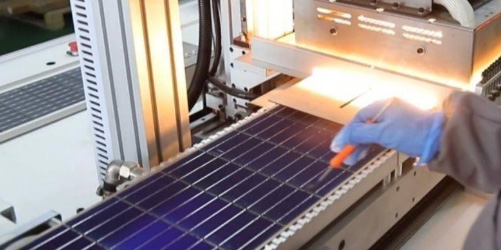
Solar panels (also known as PV modules) convert sunlight directly into electricity. As a clean and renewable energy product, they are widely applied in residential, commercial, industrial and off-grid power supply scenarios.
They can be used for household rooftop solar systems to supply power for daily home appliances, reduce electricity bills and realize self-consumption of solar power. For commercial buildings, factories and warehouses, large-scale solar panel arrays help enterprises cut grid electricity cost and meet carbon reduction targets.
Solar panels are also popular for off-grid projects. They can work with solar inverters and lithium batteries to provide stable power for remote villages, mountain areas, cabins, telecom base stations, traffic signal lights, water pumping systems and agricultural irrigation where the public power grid is unavailable.
In addition, solar panels are adopted for mobile power systems, RVs, boats and outdoor equipment. Combined with hybrid on/off-grid inverters, the excess electricity generated by panels can be fed back to the grid for net metering in regions permitted by local utility companies.
China is the world’s dominant manufacturing and exporting base for photovoltaic products, supplying around 80% of global PV module shipments. Chinese solar panels have been exported to more than 200 countries and regions across Europe, Asia, Africa, the Middle East and Latin America, supporting residential rooftop projects, commercial distributed power plants and large utility-scale solar farms worldwide.
According to official customs and CPIA (China Photovoltaic Industry Association) statistics, China exported 236.2 GW of PV modules in 2024. In the first half of 2026, the total export value of Chinese photovoltaic products reached approximately 17.18 billion US dollars, with export volume of PV modules at about 262 million pieces. The European market remains one of the largest consumption regions; the Netherlands, Spain and France are the top importing countries within the EU. The Netherlands acts as a key logistics hub, and massive volumes of Chinese PV modules are transshipped from the Netherlands to Germany, the United Kingdom and other European nations.
Emerging markets show strong growth momentum. Demand from the Middle East and Africa has risen rapidly in recent years. In the first quarter of 2026, China’s PV module exports to the Middle East surged by 470% year-on-year. Pakistan, Brazil, Saudi Arabia and other South Asian and Latin American countries are also important purchasing markets, with steady demand for household off-grid solar systems and hybrid energy storage solutions.
Top-tier Chinese PV brands including Jinko, LONGi, Trina and JA Solar occupy the major share of global module supply. Our Jinko Tiger Neo N-type TOPCon bifacial solar panels (700W~720W) are fully compliant with international standards IEC61215 and IEC61730, which clears the basic certification requirements for import in most overseas countries.
The complete industrial chain in China ensures stable production capacity, reliable delivery schedule and competitive product performance. We can arrange shipment via FOB major ports like Qingdao, Tianjin and Ningbo. We support bulk container delivery and proper export packaging to protect panels during long sea transportation.
With the global trend of carbon neutrality, more families, factories and governments choose solar power to cut electricity expenses and reduce carbon emissions. China’s mature PV supply chain continues to provide high-efficiency, A-grade solar modules for global renewable energy projects.